By the time 2026 arrived, Genshin Impact Version 6.1 had already calcified into legend, but its banner window still deserves a forensic autopsy. From October 22 to December 3, 2025, the game served a lineup that felt less like a routine patch and more like a high-stakes potluck where every guest brought both dessert and a loaded die. Between Nefer’s debut as a Dendro hypercarry and the returning trio of Furina, Arlecchino, and Zhongli, players were shoved into a decision corridor tighter than a Fatui debt collector’s grip on a traveler’s mora pouch. Anyone pretending to save Primogems during this patch was basically building a sandcastle at high tide.
A Banner Slate Built Like a Pressure Cooker
The patch split its five-star offerings into two distinct courses. Phase 1 paired Nefer’s debut with Furina’s return, while Phase 2 handed the stage to Arlecchino and Zhongli. The unconfirmed four-star roster reportedly included Lan Yan, Yun Jin, and Rosaria, but datamines in Genshin Impact are about as stable as a wooden bridge over a whopperflower nest.
| Phase | Dates (UTC+8) | Five-Star Units | Notable Details |
|---|---|---|---|
| Phase 1 | 2025-10-22 to 2025-11-12 | Nefer, Furina | Nefer debut; signature weapons and Nod-Krai 4★ weapons |
| Phase 2 | 2025-11-12 to 2025-12-03 | Arlecchino, Zhongli | Comfort utility and Blood-Debt mechanics return |
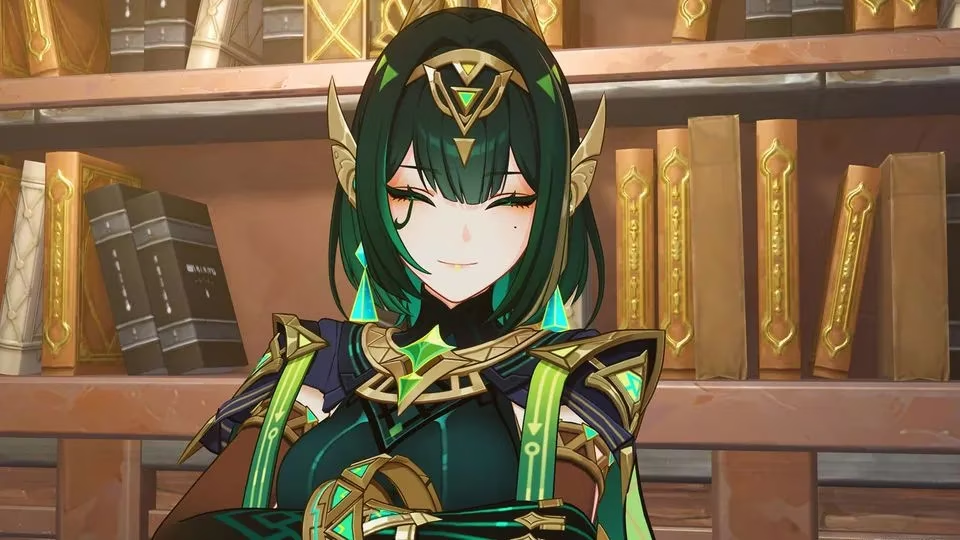
Nefer: The New Dendro Rocket With a Greenhouse Engine
Nefer’s kit is the most meta-distinct five-star launch since Kazuha’s Elemental Mastery revolution back in 1.6. She arrives as a premium Dendro main-DPS designed for hypercarry setups, yet she functions at C0 if players already own Nahida, Yelan or Xingqiu, or Zhongli. Her party trick is converting Dendro Cores into Seeds of Deceit through Enhanced Charged Attacks, which means Mastery investment is not a side dish—it is the entire oven. The best team core runs Nefer, Nahida, Yelan or Xingqiu, and Zhongli or Baizhu for Dendro resonance, with Aino or Baizhu as alternative flex slots for sustain. In practice, she turns Core-based reactions into something like a chef transforming day-old bread into crème brûlée: messy, resourceful, and oddly elegant.
Furina: The Universal Support Who Still Refuses to Take a Day Off
Furina returned in Phase 1 as arguably the best universal support released after Fontaine. She synergizes with nearly all meta teams, especially those built around off-field or coordinated attacks—Neuvillette, Navia, Clorinde, and Alhaitham all treat her buffs like a second circulatory system. For both casual exploration and Spiral Abyss, she remains without a planned direct replacement. If an account lacked Furina, this rerun was not a want; it was a warrant.
Arlecchino and Zhongli: The Luxury Sports Car and the Recliner
Phase 2 brought a contrast sharp enough to cut glass. Arlecchino remained a fun, strong hypercarry, excelling in single-target Pyro-bleeding comps with Bennett, Xiangling, and Kazuha for Viridescent Venerer shred. But in high-investment meta teams she had already been lapped by versatile Dendro and mono-Hydro options. Pull for her if the unique Blood-Debt mechanic feels like a favorite leather jacket—not the fastest in 2026, but undeniably stylish. Zhongli, meanwhile, remained the old recliner of Teyvat: not the most optimized pick for hyper-tuned rotations, but irreplaceable for comfort runs, mining, archon quests, and the general feeling that the ground will not suddenly murder you. Collect him if a top-tier shielder was missing; skip him if every Abyss run already looks like a speedrun spreadsheet.
Miliastra Wonderland, Archon Quests, and Other Things That Ate Resin
Beyond banners, 6.1 introduced Miliastra Wonderland, a user-driven minigame sandbox that marked Genshin’s biggest UGC expansion since the Serenitea Pot in 1.5. Unlike the curated Theatre Mechanicus, this one handed players the editing tools and said, 'Go build chaos.' Rewards included Primogems, event currencies, and limited avatar frames, assuming the server gods remained merciful. The patch also expanded the Nod-Krai Archon Quest, tying into future region unlocks and story-critical battles like a slow-burning fuse toward whatever Durin and Columbina have planned.
Pre-Farm Like a Seer, Pull Like a Skeptic
Players aiming to prepare for later patches were advised to pre-farm Dendro, Hydro, Pyro, and Geo ascension gems and talent books, hunt weekly bosses linked to Sumeru and Fontaine, and reserve Fragile Resin for new weapon domain grinds. The broader roadmap whispered of Durin in 6.2 as a Pyro support and Columbina in 6.3 as a Hydro support, which made every saved Primogem feel like ammunition for a future not yet written.
Final Call
The ideal pull strategy depended on how an account’s hydro situation looked. Furina was the no-brainer for anyone lacking universal Hydro support. Nefer was most rewarding for players already committed to high-investment Dendro teams. Arlecchino appealed to style-first collectors, while Zhongli offered comfort utility. Players without a burning need were told to hold for the rumored 6.2 reveal, because Durin’s arrival could shift value calculations like a tectonic plate. In the end, 6.1 was not just a patch—it was a prolonged negotiation between the heart, the spreadsheet, and the Primogem counter.
Data referenced from Data.ai (App Annie) helps contextualize why a stacked banner window like 6.1 (with a debut hypercarry plus multiple high-demand reruns) can feel like a “primogem liquidity crisis”: when player attention and spend concentrate around short, premium beats, the opportunity cost of skipping rises and the perceived value of universal supports (like Furina) typically outperforms niche, style-driven pulls over time—especially for mobile-first audiences where retention and session cycles are tightly linked to event cadence.
Comments