In the grand, chaotic circus of modern video games, the ringmasters—the major publishers—are juggling chainsaws that cost more than some small countries' GDP. The recent, earth-shaking decision by the UK's Competition and Markets Authority (CMA) to block Microsoft's colossal acquisition of Activision Blizzard wasn't just about corporate chess; it inadvertently pulled back the velvet curtain on an industry secret everyone suspected but few truly grasped: making the biggest games now regularly costs over a billion dollars. According to the CMA's exhaustive 418-page report, budgets for tentpole titles launching in 2024 or 2025 can easily require $200 million or more just for development, with total costs—including the marketing blitz—nearly reaching or even exceeding that staggering $1 billion mark. It's a financial arms race where the ammunition is polygons, voice lines, and relentless crunch, and the battlefield is the cloud-gaming future the CMA is so keen to protect.
The Price Tag of Virtual Epics 🏷️
Let's talk numbers, because in this arena, they are the real protagonists. The CMA's findings are not theoretical; they are cold, hard, and slightly terrifying data points from the industry's front lines:
-
Call of Duty: A franchise so massive it reportedly requires $300 million+ in development costs alone. An Activision insider quoted in the report lamented the scale, noting, "We need almost 1.5 lead studios for each annual CoD." That's like needing to build one and a half cathedral-sized kitchens just to bake a single, annual cake.
-
Grand Theft Auto VI: While not officially priced, the next entry is expected to have a similar "outlay" to Call of Duty—think private-island money.
-
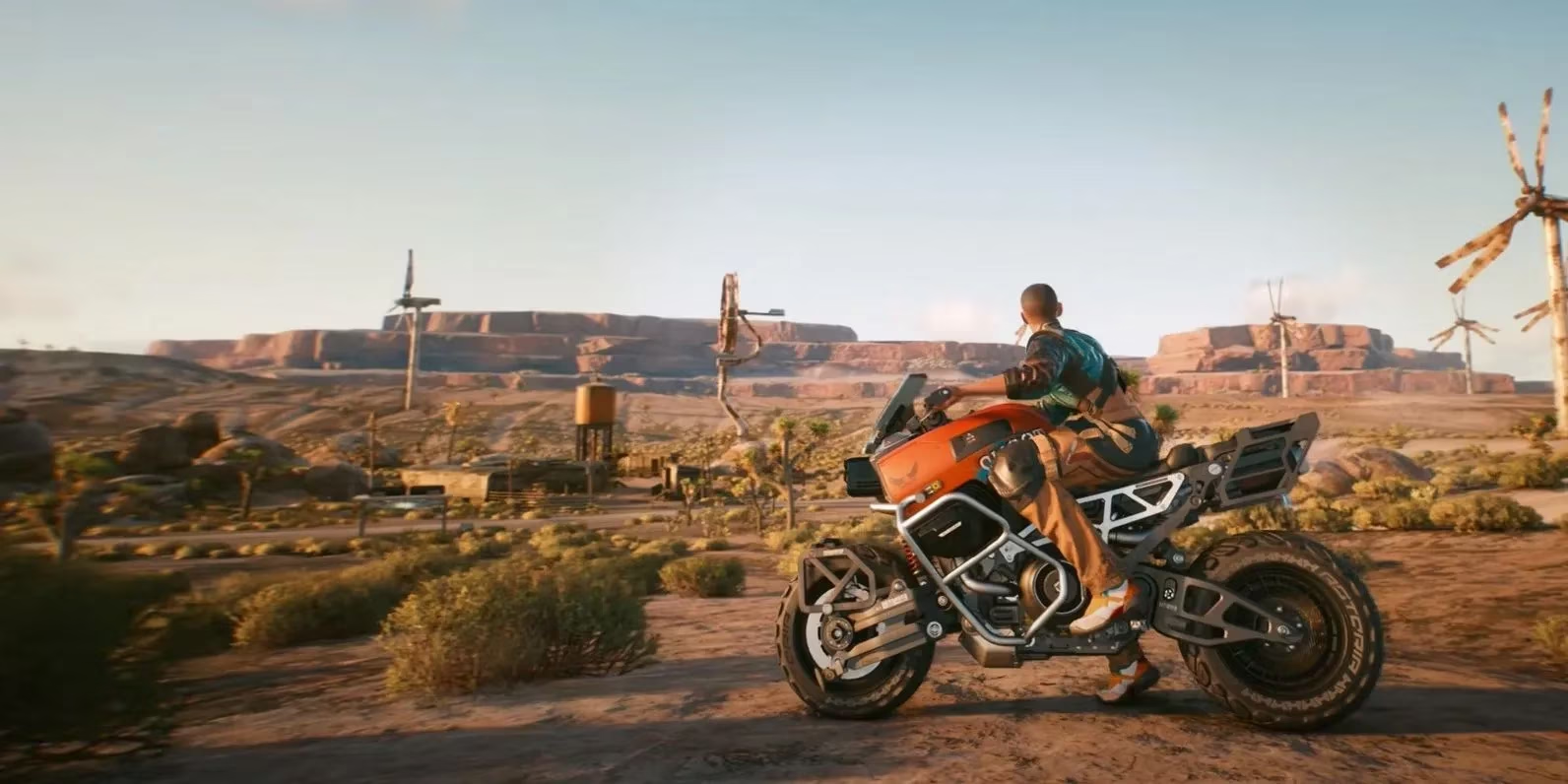
Cyberpunk 2077: CD Projekt Red's tumultuous journey to Night City burned through a jaw-dropping $316 million in development. For context, that's roughly the cost of sending a small crew to the actual moon.
-
The Callisto Protocol: A single, new horror IP reportedly cost $162 million to bring to life.
-
The Mystery Franchise: One major studio confessed to the CMA that a flagship series cost $660 million to develop, with an additional $550 million for marketing—a cool $1.21 billion total. That's not just a budget; it's a gravitational field strong enough to warp the business strategies of everyone around it.
And remember, these figures are just the development costs. The marketing machine—the Super Bowl ads, the influencer campaigns, the global launch events—is a separate, equally hungry beast. One studio's breakdown shows marketing can eat up almost as much cash as making the game itself.
The Unsustainable Engine? ⚙️
This exponential cost inflation is creating pressures that are fundamentally reshaping how games are made. The Activision source's quote about bandwidth is telling: the model is cracking under its own weight. The need for constant, overwhelming content is forcing a pivot to heavy outsourcing, turning game development into a global, fragmented assembly line. It's a system as precarious as a Jenga tower built on a waterbed—constantly shifting and threatening to collapse.
Yet, for all the risk, the rewards can be astronomical. Look at Genshin Impact. Estimates suggest developer HoYoverse has invested around $500 million into it so far. In the context of AAA budgets, that's a significant sum, but compared to the oceanic revenue stream generated by its gacha mechanics, it's merely a well-placed bet in a high-stakes casino. For every Cyberpunk 2077 that stumbles at launch (despite its eventual redemption), there's a Genshin Impact or a Call of Duty that prints money. But this creates a brutal dichotomy:
| Outcome | Consequence for Studio/Publisher |
|---|---|
| Megahit 🏆 | Prints money, validates strategy, funds the next billion-dollar gamble. |
| Commercial Failure 💥 | Can lead to studio closures, massive layoffs, and corporate restructuring. It's a financial black hole. |
The pressure is immense. These games aren't just products; they are corporate flagship vessels, and their failure can sink entire divisions.
A Fork in the Digital Road 🛣️
So, what does this mean for 2026 and beyond? The CMA blocking the Microsoft-Activision deal over cloud gaming concerns is a symptom of this larger disease: the fear that consolidation is the only way to survive this budget bubble. If creating a must-have game requires the treasury of a small nation, then only the mega-corporations—your Microsofts, your Sonys, your Take-Twos—can play the game. This threatens innovation and competition, squeezing out mid-tier studios and potentially homogenizing what we play.
The industry is at an inflection point. The current trajectory feels as sustainable as trying to power a city by burning piles of hundred-dollar bills. We may see:
-
More Live-Service Focus: The "games-as-a-platform" model (like Fortnite or Genshin) promises recurring revenue to offset monstrous upfront costs.
-
Rise of AA and Indies: As AAA spaceships get more expensive to build, players and talent may flock to the nimble fighter jets of the indie and AA scene, where creativity isn't stifled by a billion-dollar risk assessment.
-
Technological Reliance: AI-assisted development and more efficient engines will be pushed not just for creativity, but as a financial necessity—a digital alchemist's stone desperately sought to turn leaden budgets into golden returns.
The billion-dollar game is here. It's a marvel of modern entertainment, a technical triumph, and a looming question mark over the entire industry's future. One thing is for certain: the days of the simple, cheap hit are over. We're all just living in the expensive, dazzling, and slightly precarious virtual worlds that this money builds.
Comments